Showing posts with label Turing's Sunflowers. Show all posts

Friday, 25 October 2013

Ice, Art & Urban Farming

Guest Post: Caroline Ward - filmmaker and visual artist
I was thrilled to attend the Festival launch this year. Since I moved to Manchester in 2010, I've volunteered my skills to the festival by editing short content for the citizen science projects, last year for Turing's Sunflowers and this year for Hooked.
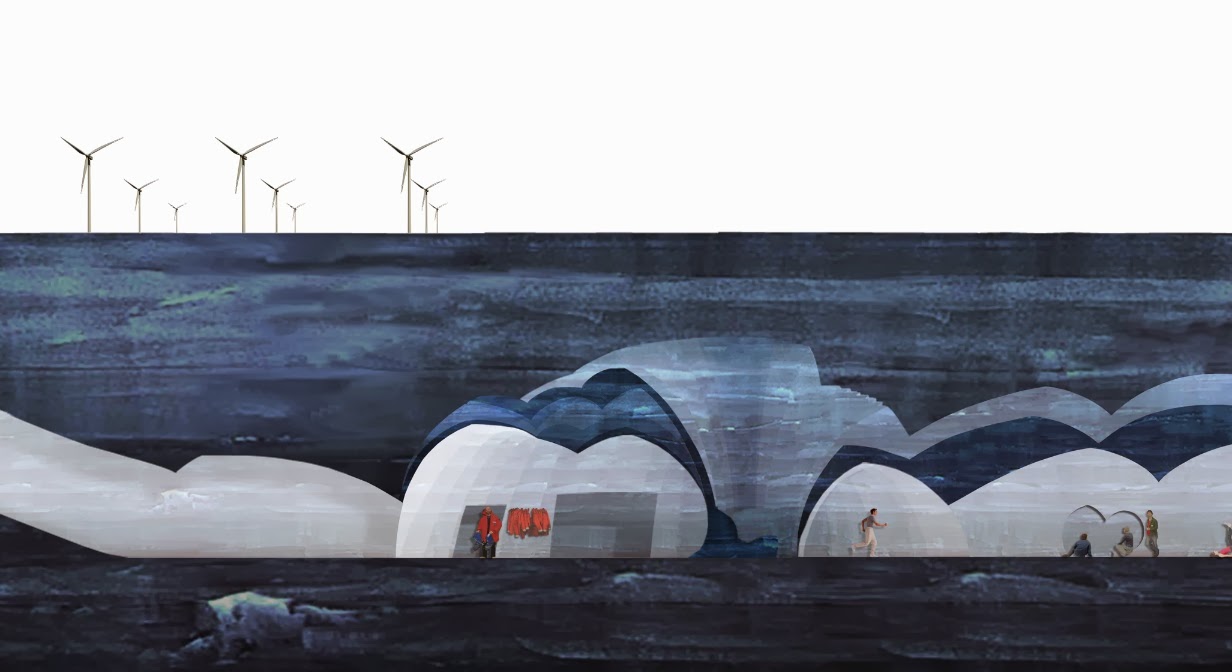
I also love going to events at the festival - particularly as my interests in art, architecture, and urban farming - never fail to be excited. At the launch I was captivated by the approach of David Garcia, one of the architects in the Ice Lab exhibition - with a structure made of snow - the idea was to use materials from the immediate environment which could then, merge back into the environment. It reminded me of Robert Smithson’s sculpture Spiral Jetty. The exhibition is fascinating and covered in a previous post. My inner kid also liked the Star Wars style structures that feature in so many of the ice labs.

There's so much going on at the festival, here’s my own navigation through the programme. As an art, film and urban naturalist, my top picks are:

A special mention goes to the Great White Silence - its one of my favourite films and fully restored to its original glory by the BFI (where I used to work many moons ago). It's the poignant story of Captain Scott’s race to the South Pole yet reveals wonderful moments like penguins captured on film for the first time in this environment. And finally - to Chasing Ice - a brilliant film that just goes to show the value of picking up a camera (well several cameras) and persisting against ice and snow to show the world just what damage we are doing to the planet – I can’t think of a better way to show climate change in action.
PS my track for the HookedPlaylist is: Violin Phase by Steve Reich (see video)

Wednesday, 7 November 2012

Manchester Science Festival is over...until next year!

Manchester Science Festival is over for another year and we've had a blast! We promised you 9 days of action-packed geek-tastic fun and what an amazing week it was! We've pulled together a selection of highlights.

Domino Computer Challenge
For what was one of the largest attempted domino-based computers, the team created the chain, domino by domino, and then ran it to work out a simple calculation. Once the machine was set in motion, the audience could see the information travelling along the lines of dominoes, and learned how computers work in a similar way. This fantastic event at MOSI played out to a packed audience. It took 10,000 dominoes, 1 day to build, months of planning and just seconds for the dominoes to fall.


The Science of Fish and Chips
At this event at the University of Salford, visitors were served traditional fish and chips from a handy fish and chips van. Five different varieties were served and tasters were encouraged to identify which fish they were eating. Dr Stefano Mariani from Salford's School of Environment and Life Sciences explained the implications on marine eco-systems of over-fishing certain species whilst demonstrating to visitors and their children how different fish look and taste. This blogger tried the fish and chips and can tell you it was delicious!


Science Junkie LIVE
Science is the most extreme of sports. In fact, it is even more important in high adrenaline physical adventures. This live outdoor show, pitted the talents of free-runner Alex Potts against mountain bike superstars Andrei Burton, Joe Seddon and Jack Gear (presented by Greg Foot and Nick Insley and produced by Huw James) all with a heavy bass soundtrack. As the guys flipped and spun through the air confidently, Greg explained to the audience what intense forces were acting on their bodies explaining the control required to make such dare-devilry look effortless.The crowd oohed and aahed as the bikers did bunny hops and flips over the course, while the audience were encouraged to cheer for man or machine in a series of exciting gravity-defying challenges.


Turing's Sunflowers Spirals Count
Members of the public joined Jonathan Swinton and researchers from The University of Manchester to find out how Turing's Sunflower growers contributed to the mathematical story of how sunflowers grow. The results were announced alongside a screening of Turing's Sunflower Diaries, crowd-sourced from footage shot by growers and directed by BBC Outreach staff volunteers. Take a look at the video to find out more.


Moon
Shown in MOSI's 1830 warehouse, this film  directed by Duncan Jones (son of David Bowie), explores what it means to be human. Packed with film fans, it was the last in a series of screenings in the atmospheric pop-up cinema space and was also the last event on the very last night of the festival. This moving and often hilarious film was introduced by guest Duncan Wilson who went on to lead a post-film discussion about the themes. 

We'd like to take this opportunity to thank you all for coming to our events and getting involved in what we think was the best festival yet! We loved every minute and can't wait for next year. 

If you took any photos of your experience, we'd love to see them! Please share them on our Flickr page and let us know what you thought of this year's festival by filling in a quick 2 minute survey. 

Get the latest news on Facebook and Twitter and subscribe to our e-newsletter.

Monday, 28 May 2012

How and why to look after your Turing's Sunflowers


Our project Turing’s Sunflowers is in full swing. We’ve had some brilliant planting events at MOSI and other partner venues like Manchester Museum and over 8000 sunflowers have been pledged on the Turing’s Sunflowers website. It’s been such a fantastic response.

The next step of the project now everyone’s seeds are in the ground, is the “nurturing phase”. Every day the Festival team are checking our sunflowers at MOSI and at home, watering them, removing pests and trying to prevent slugs. Some of them are also getting a little heavy and leaning over, so we’ve been lightly tying them to stakes in the ground. We need you to do the same!

In this hot weather keep your sunflowers well watered, but be careful not to over-water as this can loosen the soil and your plant might lean over. Mix in some liquid feed about once a month for good health!

As well as inspiring people with maths in nature, and Alan Turing’s work, what we’re really trying to achieve is lots of data from everyone’s lovely sunflowers. When they are in full bloom, we’ll be launching the next phase of the project with details of the information we need from your you. The main things to look at will be the Fibonacci patterns in the seed heads, the petals and the bracks (the green bits on the back of the flowers).

It’s fairly well documented that you can see Fibonacci patterns in nature, but it really is anecdotal. There have only been a few small scientific studies on this and we want to collect a large amount of data (from about 3000 sunflowers to be precise) to form the largest study of this phenomena. The reason for doing this is the data will be useful to tell us how often this pattern is found in nature. We’ll make this data and photos available to others, so plant scientists and others can use the large data set for their own work. One of the principles underpinning science is experimentation and the replication of such experiments. It will help to further our understanding of the frequency of this pattern, what pattern or shift from the Fibonacci sequence we get if the sequence doesn’t occur, and perhaps why they appear in nature so ordered and regimented.

More information about how to spot the Fibonacci patterns in your sunflowers and how to count these patterns will be coming over the summer here on our blog and the Turing’s Sunflowers website.  

Wednesday, 25 April 2012

Are you planting a Turing Sunflower yet?

It's been an exciting week at Festival HQ. The new Turing's Sunflowers website launched, people have pledged to grow over 2000 sunflowers, we've had 18,000 seeds delivered, and of course we've been beavering away making plans for the Festival programme in October.

I took some time out from the week to plant some more seeds and look after my sunflower seedlings. It's been a little cold, but with a bit of warmth and a few rays of sun they've starter to sprout! 


So now is the time for you to get planting and join our big experiment... 

Head over to the Turing's Sunflowers website which will tell you loads about the project, how to plant your sunflower seeds, tips for the best flowers and more. There's also more information about what we're doing and why. More will be added to the site over the next month or so and we'll be getting to grips with the maths! You can share your stories with us online too. There will also be planting events and counting events taking place which will be listed on the Turing's Sunflowers and MSF websites. 

Turing's Sunflowers is inspired by maths and nature, and the links between the two that Alan Turing was exploring before he died. There's been such a fantastic response to the project from across the globe - from families wanting to contribute to some real science research to people really connecting with local hero Alan Turing. It's a brilliant project, but it takes people like you and our partners to really get behind something, make it exciting and make it happen. So thank you for such an enthusiastic response and your support. Please do spread the word... we need you to grow over 3000 sunflowers to help us collect the data we need! That's a lot, but we can do it. So get your seeds at the ready and get planting!

Happy planting!

Natalie, Manchester Science Festival Director

Friday, 16 March 2012

The wonder of maths in nature


Last week we were lucky enough to be joined by Jonathan Swinton, a Professor in Systems Biology who conceived of the Turing's Sunflower project for this year's festival.

Over several coffees in the MOSI cafe, Jonathan explained the mathematical concepts behind his idea to do a mass participatory experiment to build on the final work of Alan Turing in his centenary year.

World famous for his code-breaking skills and contributions to computing, Turing was also fascinated with the mathematical patterns found in plant stems, leaves and seeds, a study know as phyllotaxis. This was a key element to his research when he came to The University of Manchester.

Turing noticed, for example, that the number of spirals in the seed patterns of sunflower heads (and pine cones as Jonathan shows MOSI's marketing team in the picture) often conform to a number that appears in the mathematical sequence called the Fibonacci sequence (0, 1, 1, 2, 3, 5, 8, 13, 21, 34, 55, 89…). Turing set out to explain how this might help us to understand the growth of plants. Sadly, he died before his work was complete and since then scientists have continued his work, but to properly test these hypotheses we need lots of data… and sunflowers are perfect for the job, so long as we can grow enough of them!

And that is the challenge... join us this spring to Grow a Turing Sunflower to celebrate his centenary and build on Turing's legacy to Manchester and indeed the world!

Up for the challenge? Sign up here.

Related:
  • To read up on Turing,  Jonathan recommends Andrew Hodges 'Enigma', recently republished to mark the centenary year.
  • Watch the ONE SHOW's take on the project featuring Jonathan and those all important spirals. Available on iplayer for a week (UK viewers only)

Thursday, 15 March 2012

The wonder of the simple sunflower


We've been reminiscing a little in the festival team, remembering back to growing sunflowers as kids in our back gardens. The memory of these magnificent yellow flowers towering over the garden fence is etched into our minds. Recently we've been rediscovering the wonder of the simple sunflower as part of the Turing's Sunflower project and have been amazed at the facts that we've uncovered en route.

We were pretty amazed to discover that there is a guerilla gardening day on the 1st of May devoted internationally to growing sunflowers. An event that could prove timely to this project!

We've also discovered some pretty incredible facts about sunflowers... here's our top five so far in now particular order.

1. The seeds make a tasty and healthy snack. You can eat them (and feed birds with them too) and cook with the oil pressed from them. Indeed the sunflower is the symbol of the vegan society and licensed for the sale of sustainable products.

2. You can create other useful and sustainable products including biodiesel as an alternative to petrol.

3. Sunflowers are a great learning resource to teach maths, biology and science. Baby sunflowers apparently track the motion of the sun across the sky, a phenomenon known as heliotropism. Further, the seeds grow in a spiral pattern in the sunflower head and if you count the spirals you will, more often than not, find that the number of spirals corresponds to numbers found in a mathematical sequence called the fibonacci sequence.

4. Sunflowers can be used to extract toxic chemicals from soil, including lead, arsenic and uranium, a process called phytoremediation. Through this process plants can naturally help alleviate environmental problems. Sunflowers were apparently grown to help reduce toxins after the Japanese Fukushima nuclear disaster.

5. Sunflowers are part of a rich cultural and artistic heritage with many artworks and cultural practices associated with sunflowers. Van Gogh's Sunflowers is perhaps the most obvious example but more recently Chinese Artist, Ai Wei Wei's sunflower seed installation has been in the news recently with Tate Modern buying 8 million of the 100 million porcelain sunflower seeds produced as part of the artwork. Bring the conversation back to food, we also discovered recently as the Manchester Histories Festival that sunflower seeds are handed out as a snack to celebrate Chinese new year.


To share and discover more about these amazing plants, including how to grow them, join us on an incredible and hopefully memorable challenge as part of the festival to Grow a Turing Sunflower (or 2 or 3 or 5 or 8 or 13 or more!)...
Monday, 5 March 2012

Turing's Sunflowers


You may remember that back in December we were on the hunt for a dynamic project manager to deliver a mass-participatory experiment across the whole of Manchester following in the steps of Alan Turing to raise awareness of maths in nature? Well, we're pleased to announce the search is over and Dr Erinma Ochu, ex-Manchester Beacon director has recently joined the Manchester Science Festival team to bring you Turing's Sunflowers. 


More info, including how to get involved in the biggest city-wide research experiment, coming very soon. Can't wait that long? Erinma will be talking briefly about the project at Social Media Cafe Manchester (SMC_MCR) tomorrow night in the Northern Quarter. 


Welcome on board Erinma!


Related info:

SMC_MCR takes place: 6pm – 9pm, Tuesday 6 March 2012.
Venue: Matt & Phreds, 64 Tib Street, Manchester, M4 1LW