Wednesday, 23 October 2013

Is breathing bad for you?


Could a stroll down Oxford Road be bad for your health? Find out with the Barometer Podcast team on the 29th October at Manchester Museum during a LIVE podcast recording. Doors open at 1830 for a 1900 start. The event is free to attend. More details are available here and you can guarantee your seat here. Podcast team member, Will Morgan explains some of the science behind air pollution and why it is bad for our health.

Air pollution has been a major issue in Greater Manchester since the Industrial Revolution, with the smoke emanating from the many factories leading to smog settling over the city. The author Johanna Schonpenhauer remarked in 1830 that Manchester was:
“Dark and smoky from the coal vapours, it resembles a huge forge or workshop.”

Several of Lowry’s paintings depicted the smoke and haze coming from factories in Salford. As industrialisation and motor vehicles spread across the globe, so did the issue of air pollution. Just this week, Sydney has been blanketed by dense smoke from bush fires, while a city in Northern China is suffering with air pollution levels that are 40 times the safe limit recommended by the World Health Organisation. These are very visible examples of air pollution but often the problem is what we don’t see. Even relatively low levels of air pollution can be harmful to our health, especially if we are exposed for long periods.
  Manchester Museum’s spider crab helps me make some pollution measurements on Oxford Road.
Breathing in the fumes from cars, factories and anything else that involves burning fuel can have serious short and long-term implications for our health. Air pollution has been linked to both causing and aggravating heart and lung diseases. Globally, these are the leading causes of death and air pollution makes them worse. The World Health Organisation recently declared that air pollution is a leading environmental cause of cancer deaths. During and after major air pollution events, the number of people suffering heart attacks and respiratory problems increases.

The most dangerous type of air pollution is from tiny particles that are suspended in the air, known as aerosols or particulate matter. These are estimated to have contributed to around 3.2 million deaths in 2010. A recent report by the European Environment Agency concluded that around 90% of people living in European cities are exposed to levels of air pollution that are damaging to our health. Closer to home, it is estimated that nearly 29,000 deaths each year in the UK occur due to particulate matter pollution. Across Greater Manchester, between 1 in 17 and 1 in 19 adult deaths are attributable to particulate matter pollution.
Efforts to improve the situation have been mixed, as air pollution is a complex conundrum for both scientists and policy makers. If you want to hear more about this important issue, then I recommend joining us next Tuesday at our live podcast: Is breathing bad for you? 7pm at the Manchester Museum. See you there.

Tuesday, 22 October 2013

Guest post from Liz West, artist exhibiting at the Synthesis exhibition.
the curator of Synthesis ,Tracie Shaylor had visited and seen recent work at Bury Light Night and immediately wanted me in the show. The in-depth colour theory that I employ in all my light works ties in neatly with the exhibition being part of Manchester Science Festival.
I am most excited by site-specific work. If I was to be part of this exhibition I
wanted my ideas to be responsive to the space. With that in mind last Thursday I was given a tour of the ground floor exhibition space at Manchester's Victoria Warehouse. I had been keen to get into the space for some time and didn't want to waste this opportunity.
Upon entering the exhibition space I was blown away by the possibilities for new work, my mind started racing. Tracie had ear-marked two particular spaces for my work, upon inspection they are not the easiest to work with, but these are the spaces I am excited by the most. I like a challenge.
One of the spaces was in front of a vast window looking on to the main road past the Warehouse. A light-work would defiantly attract passers-by and act as an advertisement for the show. I aim to rework the recent commission I made for Macclesfield's Barnaby Festival by stacking the light boxes on top of each other instead of presenting them side-by-side. Configured this way it would lend itself to the space and illuminate the nearby white walls.
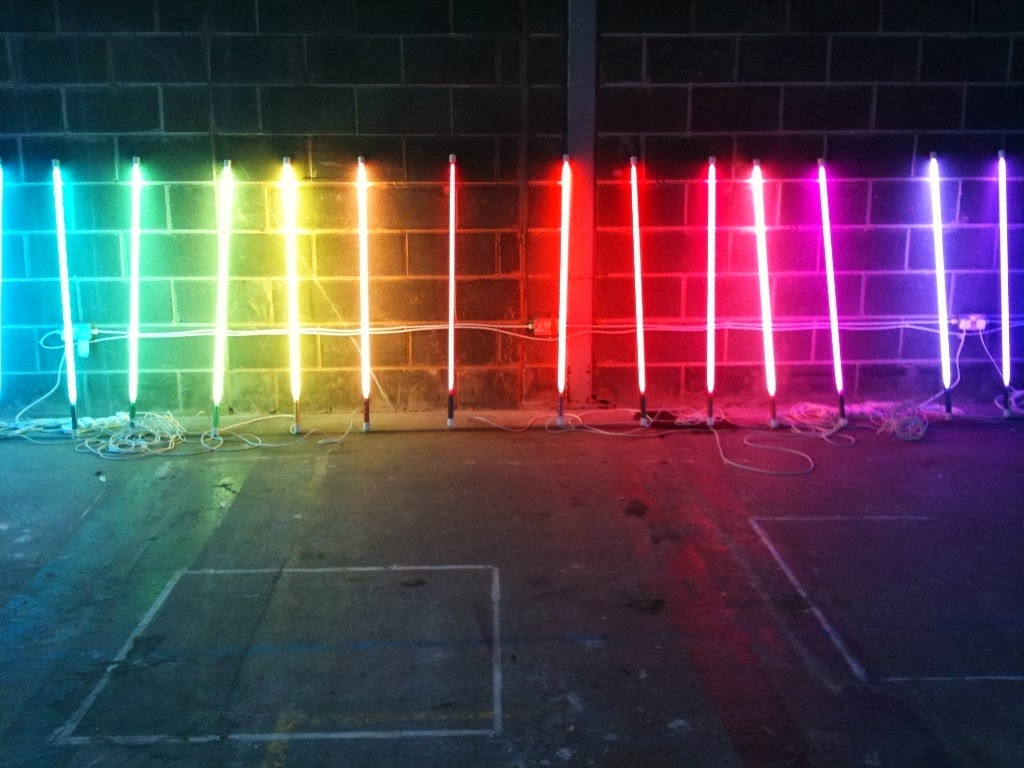
The second space is within the main exhibition hall. A set of blue railings guard a drop down to the floor below; this was the space I had to respond to! In this site-specific installation conceived specially for Synthesis, I will systematically arrange numerous multicoloured fluorescent stick-lights. The title of work is taken from Josef Albers text ‘Interaction of Colour’, where it is explained that a direct mixture of projected light demonstrates an additive mixture where the sum of all colours in light is white. I am super excited about it and as with most of my installations, you have to see them in the flesh to fully appreciate.

I can't wait to install these works and perhaps see you at the preview on Thursday evening?
Find out more about the preview event here and the Synthesis exhibition here. The Synthesis exhibition is at the Victoria Warehouse hotel from Friday 25 Oct - Sun 10 Nov.

Thursday, 10 October 2013

Portraits of Emotions 
Guest blog post by artist Paul Digby, who will be exhibiting at the Synthesis exhibition at Victoria Warehouse.


The four drawings on display are from a series of ten portrait drawings of people from the Chapeltown area of Leeds. I worked from photographic images made in an open studio in early 2012 where people were asked to express an emotion of there own choice. The idea for this grew out of Charles Darwin's Expressions of Emotions in Man and Animals, where in this book Darwin uses photographs by the mid nineteenth century French Doctor/Photographer Duchenne de Boulogne of an "Old man". 

The old man was a homeless person he worked with who reportedly had no nerve endings in his face and was able to have electrodes attached to emulate specific emotions.

I initially asked people to express specific emotions but soon adapted to people's desires to express emotions of there own choices. As the project progressed I felt more confident to ask specific individuals if they would pose and I selected people from the community I knew to ask.


Another artistic reference is George Seurat and particularly his drawing style. Although Seurat used Conte Crayon and I have used Graphite, I adapted his process. This involved repeating a circular movement and pattern to gradually build to a solid tone. I also used cross hatching, a similar technique for building layered tone. For four of the ten series I used paint and oil bar on paper and canvas. Seurat lived in Paris around the same time as Duchenne but I am unsure to whether they knew one another.

Other references involve contemporary psychology. During the project I was influenced by Bruce Hood's The Self Illusion, which seemed to link in to the concept of portraiture. Another idea that transfers well from psychology to art is stimuli and response. For example the art work is the artist's response to a stimuli and the viewer's stimuli for a response.

The project involved delivering a workshop to Chapelallerton Primary School in Chapeltown to sixty Year One children. They learnt how to draw portraits using cross hatching and graphite on a paper with a grain.

This project was supported by the University of Leeds School of Medicine who mid way through the project showed the work in progress in the Charles Thackrah Building. The full series was shown in the Union105 gallery in Chapeltown Leeds and the ESA show space in London. I also gave a lecture to Leeds Metropolitan University students, another supporting organisation. The project was funded by Arts Council England.

Paul is a contemporary visual artist with sixteen tears experience and has shown work in including the Manchester Contemporary, the Cornerhouse and the Saatchi gallery. He has collaborated on projects with in the Thackray Museum, Rampton Hospital and High Royds Hospital. Paul has work in the Wellcome Trust and Private Collections. He sits on the Steering Group for the Yorkshire and Humber Contemporary Visual Arts Network and teaches for the WEA.

Four of the series of drawings will be on display in the Synthesis exhibition and Paul will give a talk on the project, on Saturday 25th October at 4:00 both in the Victoria Warehouse Hotel.


Tuesday, 8 October 2013


Research: The Big Picture
Guest Post: Dee-Ann Johnson, The University of Manchester

What connects wishing trees in folklore, the inside of a living chrysalis, and 5000 years of weather?  The third annual Images of Research Competition that’s what! 

  As part of the Manchester Science Festival, we challenged  scientists and engineers at The University of Manchester to tell their research story using beautiful images and inspiring descriptions. We asked them to show why research is essential and important to everyone.  


Open to researchers in all subjects, the entries came with intriguing titles including:

·      Your eely ancestor
·      The fire empowerment
·      More than skin deep
·      Standing proud
·      Scientific research: A real bed of roses

The competition presents just a taste of the diversity and breadth of the research being conducted at the University. But whether the subject matter is poverty, locomotion, climate change, health or masculinity, we are sure of one thing – there is something of interest for everyone.

Our researchers are passionate about their work and the benefits their research can bring. 

  But now we turn the competition over to you

Cast your vote online now and help us decide which image has captured your imagination, raised your curiosity, or got you thinking about the research in a different way.


The competition runs from 7 October to 4 November 2013. The winner will be announced on 5 November 2013.

Saturday, 5 October 2013

#Hooked: Unlocking the Secret Science of Song


Hello festival peeps, not long to go now! I'm Erinma and last year I had a blast working on the fab citizen science experiment, Turing's Sunflowers. Now I'm back doing a residency at MOSI working with the Festival team to bring a new mass experiment to life. This time it's all about music and unlocking the secret science of song.

Back in May I went to the University of Amsterdam to meet with music cognition scientists, Dr John Ashley Burgoyne and Professor Henkjan Honing who have devised a fantastic experiment that needs your help.

Ashley and Henkjan are interested in musical memory - songs that we remember and can recall to mind just by thinking about them. The way they want to explore that is by looking at musical 'hooks' and what it is musically that makes a tune stick in our minds.

What's the idea?
Just hearing a few bars of a song, people will suddenly recall that tune to mind. The hook is the most noticeable part of a tune. It sticks in your mind and is the key to understanding why musical memories last a lifetime. The hook makes music memorable or catchy. And, songwriters, DJs and musicians know exactly how to use the hook to get everyone singing along or up on the dance floor.
Whilst visiting my family in Copenhagen I told my DJ brother, Thomas, all about #Hooked and he invited me along to Karriere bar to show me exactly how he uses hooks to get people on the dancefloor every Friday night.
Quite apart from having a great night out - it got me thinking about the wisdom of the non-science experts, DJs, musician, songwriters, music geeks and many more and making sure we include their perspectives to add a new dimension to understanding how music can play with our emotions, memories and quite literally move us.
There will be lots of personal and global stories we can tell, from the songs our parents gave us to this years top ten wedding songs to the songs that changed the world. Indeed much of human history is shared through songs.
Why does it matter?

“The past which is not recoverable in any other way is embedded, as if in amber, in the music, and people can regain a sense of identity. . .” — Neurologist, Oliver Sacks 

One of the things that I found quite astonishing is how personalised playlists of music are used in some care homes to help improve the quality of life of people with fading memories, including dementia. This phenomenon, where people are literally awakened from a stupor, and begin to dance and sing, has to be seen to be believed. So, whilst the experiment is going to be a lot of fun, it might also provide insights into long term memory and even failing memory, which could contribute to future Alzheimer's disease research.
What's the theory?


There are lots of theories about what makes music catchy (a danceable rhythm, a change in pitch etc) but little scientific evidence. By doing an experiment, designed as a game, we can test out these theories and see, for example, whether they apply to hooks in different genres of music. The game will be launched in early 2014 but in true citizen science style we want to get the public involved by kickstarting a debate on what makes music catchy.
A previous experiment analysed what makes music catchy by observing 1100 people singing along to songs out loud in pubs and clubs and concluded that the catchiest song of all time was 'we are the champions' by Queen. The scientists, musicologist Dr. Alison Pawley and psychologist Dr. Daniel Mullensiefen concluded there are four traits that make a song catchy: 1) Long and detailed musical phrases; 2) a number of pitches in the hook; 3) and male voices that are 4) high pitched. Read more about their findings here.


Mullensiefen said, “Every musical hit is reliant on maths, science, engineering and technology, from the physics and frequencies of sound that determine pitch and harmony, to the hi-tech digital processors and synthesisers that can add effects to make a song more catchy.
“We’ve discovered that there’s a science behind the sing-along and a special combination of neuroscience, maths and cognitive psychology can produce the elusive elixir of the perfect sing-along song. We hope that our study will inspire musicians of the future to crack the equation for the textbook tune.”

Read more at http://www.zmescience.com/research/studies/what-makes-a-song-catchy-science-explains/#gfmMDiDIsaarR2T2.99
Mullensiefen said, “Every musical hit is reliant on maths, science, engineering and technology, from the physics and frequencies of sound that determine pitch and harmony, to the hi-tech digital processors and synthesisers that can add effects to make a song more catchy.
“We’ve discovered that there’s a science behind the sing-along and a special combination of neuroscience, maths and cognitive psychology can produce the elusive elixir of the perfect sing-along song. We hope that our study will inspire musicians of the future to crack the equation for the textbook tune.”

Read more at http://www.zmescience.com/research/studies/what-makes-a-song-catchy-science-explains/#gfmMDiDIsaarR2T2.99
Mullensiefen said, “Every musical hit is reliant on maths, science, engineering and technology, from the physics and frequencies of sound that determine pitch and harmony, to the hi-tech digital processors and synthesisers that can add effects to make a song more catchy.
“We’ve discovered that there’s a science behind the sing-along and a special combination of neuroscience, maths and cognitive psychology can produce the elusive elixir of the perfect sing-along song. We hope that our study will inspire musicians of the future to crack the equation for the textbook tune.”

Read more at http://www.zmescience.com/research/studies/what-makes-a-song-catchy-science-explains/#gfmMDiDIsaarR2T2.99
Mullensiefen said, “Every musical hit is reliant on maths, science, engineering and technology, from the physics and frequencies of sound that determine pitch and harmony, to the hi-tech digital processors and synthesisers that can add effects to make a song more catchy.
“We’ve discovered that there’s a science behind the sing-along and a special combination of neuroscience, maths and cognitive psychology can produce the elusive elixir of the perfect sing-along song. We hope that our study will inspire musicians of the future to crack the equation for the textbook tune.”

Read more at http://www.zmescience.com/research/studies/what-makes-a-song-catchy-science-explains/#gfmMDiDIsaarR2T2.99
A related phenomenon, earworms or involuntary musical imagery, where catchy tunes get stuck in the head and uncontrollably repeat over and over, have been studied in the earwormery project by the music, brain and mind group at Goldsmith's University. They have been researching what musical features earworms have in common and what people who experience earworms might have in common. Finally they've also been looking at what purpose earworms might serve and how earworms might be cured.

Dr Lauren Stewart, from the music, brain and mind group said:
--> "What is interesting to us is the fact that this musical imagery comes to the brain without planned effort. It is as if comes from nowhere..."
The earwormery team discovered there are specific triggers for earworms - stress, sights, sounds or smells in the environment. And, just hearing a song can also trigger an earworm.

#Hooked
With #Hooked we aim to look at hooks in hundreds of thousands of songs using a name-that-tune game that asks players to recognise the song and then identify which bit in the song is the most catchy. But, as i said before, we need your help!
  
Imagine listening to a catchy tune, whats the part where you start singing out loud or start humming along? That's the hook... we want you to share your catchiest tunes and to tell us what you think makes it catchy.

Get involved
Taking part is easy, just complete this simple survey to crowdsource the playlist for the game and kickstart a debate on what makes music catchy.

Join us for the festival launch of #Hooked to debate what makes music catchy, from hooks, to earworms and hit songs with Ashley Burgoyne, Lauren Stewart and Daniel Mullensiefen. Then dance to your catchiest tunes at our silent disco.

MOSI's presenters, James and Darren, will also feature in Captain #Hooked, a daily festival show and featuring a very special guest to get the kids dancing on the 30th of October.

Meantime, tweet your catchiest tune (name & artist) to #hookedplaylist or upload a short video showing us your catchiest bit in the tune you've picked - tag your videos with hookedplaylist so we can find and share them.

Hooked is a MOSI initiative in collaboration with the University of Amsterdam, the University of Manchester and supported by the Wellcome Trust.

Monday, 23 September 2013

Behind the scenes of the Manchester Science Festival at MMU

Guest post - Jo Keogh, MMU

The Manchester Science Festival is in its 7th year and what a year it is going to be. At least that’s my opinion. My name is Jo Keogh and last year I was part of the 2012 Manchester Science Festival in MMU. I used my passion for Lichen and my artistic background to give festival goers a taste of identify and engaging with these wonderful organisms.

A year later and I am a key part of MMU ‘s Saturday ‘Brains of the Future’, previously ‘Science Extravaganza’. And even if I do say so myself this year is set to be even better.

This year instead of calling ourselves the Extravaganza we have themed our events around brains, which are an ongoing theme throughout the Festival this year.  There will be a neuron map to help you explore the space and some fantastic games, puzzles and demonstrations to tease and test your brain!

But I have not just been working with the staff and students of MMU. There is a team of partners who have all done their bit to help inspire and push this years festival to a new level.
I would personally recommend the Science after Dark, which contain some great events from MMU, including a trailblazer gothic quiz and MMU's Bad Bookclub featuring a screening of Dr Ehrlich's Magic Bullet (all about bacteria, microbes, antibiotics and more).

It has been a very exciting time of sneak peeks and curious titles. There’s a lot of hard work and dedication that has been and is still, going into the preparation for the festival launch. Make sure you don’t miss the fun view the Manchester Science Festival Guide here


Wednesday, 4 September 2013

Manchester Science Festival 2013 is here

Welcome to the Manchester Science Festival 2013. Today we are thrilled to launch our programme for this year’s Festival, taking place from Thursday 24 October to Sunday 3 November.  Check out our website for all the information or pick up a brochure from MOSI or loads of venues about the city. 

You will see that this year we have our usual packed family programme of hands-on activities and workshops to inspire and engage budding young scientists across Greater Manchester and beyond.  There is also an eclectic mix of events for discerning adults looking for alternative science (and technology and engineering and maths) entertainment: we’ve got films, plays, an art exhibition, comedy,  some special brains-themed events and more.  We’re also launching our new citizen science experiment, #Hooked, where you can get involved to help scientists unlock the secrets as to what makes music catchy.

Over the next few weeks we’ll be blogging about different aspects of the programme as we gear up for the events.  And if you are a blogger yourself – we need you!  We are looking for bloggers (or aspiring bloggers) to help us write about, document and spread the word of our Festival events.  We are holding a special bloggers event at the Brains: The Mind as Matter exhibition at MOSI on Tuesday 24 September. You can apply and find out more details here.


Manchester Science Festival is back for its seventh year, proudly produced by MOSI, supported by our headline sponsor Siemans and major sponsors Electricity Northwest, University of Salford and Waters.  The Festival is brought to you by a unique group of partners consisting of the universities of Bolton, Manchester, MMU and Salford, the Institute of Physics, the British Science Association, Sound of Science and many other supporters.  We can’t wait to hear what you think of this year’s programme.

Monday, 31 December 2012

Thank you!


With 2012 drawing to a close we've been looking back at an amazing year. Not only was it the 2012 Olympics, the Diamond Jubilee, and the year of the rain, but we had the best Manchester Science Festival yet, complete with our very first Citizen Science project Turing's Sunflowers, celebrating the life of mathematician Alan Turing.

Manchester Science Festival has fast evolved and taken shape since it began in 2007. It was an innovative and creative blend of events for families and adults when it was first established and we've taken that ethos and shaped it into one of the most cultural and vibrant Festivals on the Manchester events scene.

This year we added a film strand, co-produced at art and science exhibition, brought more art, comedy, theatre and lively debates to the programme, as well as curating a family friendly programme of events and activities. The Festival is proudly produced by MOSI, and this year we invited some of our favourites artists and communicators back, such as Helen Storey and Science Junkie, to create even more amazing live events.

It was also a first for us this year. We're proudly produced by MOSI and working together with the University of Manchester and the Manchester City Council (as well as lots more!) we created our first citizen science project Turing's Sunflowers. To celebrate the life of mathematician and code-breaker Alan Turing we invited people from around the world to grow sunflowers and explore the patterns in the sunflower seed heads. We were looking to back up Alan Turing's theory that Fibonacci patterns form in the sunflower seed heads, and sometimes, if they didn't, what would we find instead. A whopping 12,000 sunflowers were pledged to the project from countries across the globe.

So as we reflect on an amazing year, we wanted to thank everyone that was involved in Manchester Science Festival in some way; our sponsors and partner organisations, event organisers, artists, scientists, science communicators, staff at MOSI and all host venues, our designers and web team, our brilliant volunteers and most of all our wonderful visitors. We thank you all for your contribution, we wish you a fantastic 2013 and we'll see you in October!

Wednesday, 7 November 2012

Manchester Science Festival is over...until next year!

Manchester Science Festival is over for another year and we've had a blast! We promised you 9 days of action-packed geek-tastic fun and what an amazing week it was! We've pulled together a selection of highlights.

Domino Computer Challenge
For what was one of the largest attempted domino-based computers, the team created the chain, domino by domino, and then ran it to work out a simple calculation. Once the machine was set in motion, the audience could see the information travelling along the lines of dominoes, and learned how computers work in a similar way. This fantastic event at MOSI played out to a packed audience. It took 10,000 dominoes, 1 day to build, months of planning and just seconds for the dominoes to fall.


The Science of Fish and Chips
At this event at the University of Salford, visitors were served traditional fish and chips from a handy fish and chips van. Five different varieties were served and tasters were encouraged to identify which fish they were eating. Dr Stefano Mariani from Salford's School of Environment and Life Sciences explained the implications on marine eco-systems of over-fishing certain species whilst demonstrating to visitors and their children how different fish look and taste. This blogger tried the fish and chips and can tell you it was delicious!


Science Junkie LIVE
Science is the most extreme of sports. In fact, it is even more important in high adrenaline physical adventures. This live outdoor show, pitted the talents of free-runner Alex Potts against mountain bike superstars Andrei Burton, Joe Seddon and Jack Gear (presented by Greg Foot and Nick Insley and produced by Huw James) all with a heavy bass soundtrack. As the guys flipped and spun through the air confidently, Greg explained to the audience what intense forces were acting on their bodies explaining the control required to make such dare-devilry look effortless.The crowd oohed and aahed as the bikers did bunny hops and flips over the course, while the audience were encouraged to cheer for man or machine in a series of exciting gravity-defying challenges.


Turing's Sunflowers Spirals Count
Members of the public joined Jonathan Swinton and researchers from The University of Manchester to find out how Turing's Sunflower growers contributed to the mathematical story of how sunflowers grow. The results were announced alongside a screening of Turing's Sunflower Diaries, crowd-sourced from footage shot by growers and directed by BBC Outreach staff volunteers. Take a look at the video to find out more.


Moon
Shown in MOSI's 1830 warehouse, this film  directed by Duncan Jones (son of David Bowie), explores what it means to be human. Packed with film fans, it was the last in a series of screenings in the atmospheric pop-up cinema space and was also the last event on the very last night of the festival. This moving and often hilarious film was introduced by guest Duncan Wilson who went on to lead a post-film discussion about the themes. 

We'd like to take this opportunity to thank you all for coming to our events and getting involved in what we think was the best festival yet! We loved every minute and can't wait for next year. 

If you took any photos of your experience, we'd love to see them! Please share them on our Flickr page and let us know what you thought of this year's festival by filling in a quick 2 minute survey

Get the latest news on Facebook and Twitter and subscribe to our e-newsletter.

Wednesday, 24 October 2012

The Turing Project - An Interview With Jon Armstrong


This year is the centenary of wartime code-breaker Alan Turing's birth. To celebrate this, Manchester Science Festival has a whole host of events highlighting the achievements of this great man.

The Turing Project is an immersive theatre experience in which you'll become a member of a top secret group of scientists. Your role will be to safeguard an emergency communication channel, keeping it open for agents to send out distress calls. We stole a few minutes with organiser Jon Armstrong from theatre company Simply Told to find out more.


Can you tell us a bit about the Turing Project –  what can people expect from it?

The Turing Project is an immersive theatrical encounter for 4 people, based on the work of Alan Turing. The audience are thrown into the world of the wartime code-breaker, where they will have to work individually and collaboratively on breaking a cypher and establishing radio communication with a mysterious broadcast. It is then their duty to establish whether the voice they are communicating with is that of a man or a machine.
    
How did you come up with the idea for The Turing Project?

We have long been fascinated by the work of Alan Turing, and this is our attempt to allow people to experience his work and legacy. We believe that he was treated appallingly by the country that he served so well, both during the war and in his legacy beyond.
  
What do you think makes a good immersive experience?

A good immersive experience is one that is completely designed round the involvement of the audience. The outcomes of the piece will change with each audience, and we hope that this direct involvement in the performance makes for an engaging experience for both audience and us.

Have you ever had any unusual or unexpected reactions from the people who take part in your events?

We have had some very strong reactions. During the tour of The Alpha Project (which came to MSF in 2010), we had people frozen to their chair, sensing presences that weren't there and generating some incredible coincidences, amongst many others. This was due, in part, to the subject matter – the show dealt with people’s belief in psychic ability, from a purely skeptical standpoint – and it is incredible how real and involving these things can seem when you are thrust into an immersive world through which you have to find your own way.
  
What’s the best thing about your job?

The best thing about my job is the opportunities it provides to create these experiences. I strongly believe in the power of culture to change people’s perceptions and viewpoints, and I think that immersive theatre is a great way to truly involve people in a wider cultural conversation.

How important do you think arts-science collaborations like yours are?

I believe that arts-science collaborations are very important. Both worlds have an enormous amount to teach the other in terms of the development and communication of ideas, and there had been an unnecessary divide between them for too long. Collaborations such as these reach new audiences, encourage debate and hopefully broaden horizons.
     
Have you always been interested in science as an inspiration for your work?

Science has long been an inspiration. My background is in magic, which uses very rational techniques to create irrational experiences, and the world view that this encourages shares many similarities with a scientific outlook and approach. Science has fascinating stories to tell, and I believe that theatre can go some way to telling them.


Sat 27 Oct 2012 12 noon - 9pm
Sun 28 Oct 2012 12 noon - 9pm
Mon 29 Oct 2012 12 noon - 9pm

Shows start on the hour and last 30 min. Book online.


The Turing Project is available as part of our Science After Dark programme. For a full list of events inspired by Alan Turing click here. For the full festival programme please see our website. Get the latest news on Facebook and Twitter and subscribe to our e-newsletter.