Guest Post: Caroline Ward - filmmaker and visual artist
I was thrilled to attend the Festival launch this year. Since I
moved to Manchester in 2010, I've volunteered my skills to the festival by
editing short content for the citizen science projects, last year for Turing's Sunflowers and this year for Hooked.
I also love going to events at the festival - particularly as my
interests in art, architecture, and urban farming - never fail to be excited. At
the launch I was captivated by the approach of David Garcia, one of the architects
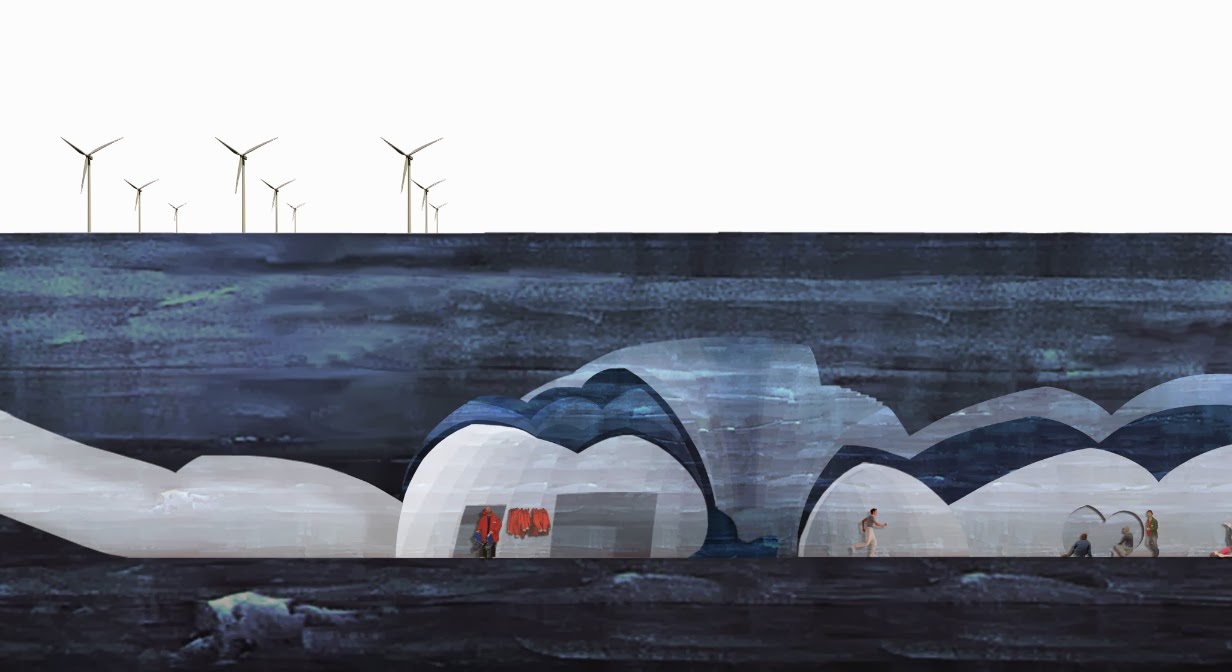
in the Ice
Lab exhibition - with a structure made of snow - the idea was to use
materials from the immediate environment which could then, merge back into the
environment. It reminded me of Robert Smithson’s sculpture Spiral
Jetty. The exhibition is fascinating and covered in a previous post. My
inner kid also liked the Star Wars style structures that feature in so many
of the ice labs.
There's so much going on at the festival, here’s my own
navigation through the programme. As an art, film and urban naturalist, my top
picks are:
A special mention goes to the Great White Silence -
its one of my favourite films and fully restored to its original glory by the BFI (where I used to work many moons ago).
It's the poignant story of Captain Scott’s race to the South Pole yet reveals wonderful
moments like penguins captured on film for the first time in this environment.
And finally - to Chasing Ice - a brilliant film that just goes to show the value
of picking up a camera (well several cameras) and persisting against ice
and snow to show the world just what damage we are doing to the planet – I can’t
think of a better way to show climate change in action.
PS my track for the HookedPlaylist is: Violin Phase by Steve Reich (see video)
Hello
festival peeps, not long to go now! I'm Erinma and last year I
had a blast working on the fab citizen science experiment, Turing's Sunflowers. Now I'm back
doing a residency at MOSI working with the Festival team to bring a new mass
experiment to life. This time it's all about music and unlocking the secret
science of song.
Back
in May I went to the University of Amsterdam to meet with music cognition
scientists, Dr John Ashley Burgoyne and Professor Henkjan Honing who have
devised a fantastic experiment that needs your help.
Ashley
and Henkjan are interested in musical memory - songs that we remember and can
recall to mind just by thinking about them. The way they want to explore that
is by looking at musical 'hooks' and what it is musically that makes a tune
stick in our minds.
What's the idea?
Just hearing a few bars of a song, people will suddenly
recall that tune to mind. The hook is the
most noticeable part of a tune. It sticks in your mind and is the key to
understanding why musical memories last a lifetime. The hook makes music
memorable or catchy. And, songwriters, DJs and musicians know exactly how
to use the hook to get everyone singing along or up on the dance floor.
Whilst visiting my
family in Copenhagen I told my DJ brother, Thomas, all about #Hooked and he
invited me along to Karriere bar to show me
exactly how he uses hooks to get people on the dancefloor every Friday night.
Quite apart from
having a great night out - it got me thinking about the wisdom of the non-science experts, DJs, musician, songwriters, music geeks and many more and
making sure we include their perspectives to add a new dimension to understanding
how music can play with our emotions, memories and quite literally move us.
“The past which is not recoverable in any other way is embedded, as if in amber, in the
music, and people can regain a sense of identity. . .” — Neurologist, Oliver Sacks
One of the things
that I found quite astonishing is how personalised playlists of music are used
in some care homes to help improve the quality of life of people with fading
memories, including dementia. This phenomenon, where people are literally
awakened from a stupor, and begin to dance and sing, has to be seen to be
believed. So, whilst the experiment is going to be a lot of fun, it might also
provide insights into long term memory and even failing memory, which could
contribute to future Alzheimer's disease research.
What's the theory?
There are lots of
theories about what makes music catchy (a danceable rhythm, a change in pitch
etc) but little scientific evidence. By doing an experiment, designed as a
game, we can test out these theories and see, for example, whether they apply
to hooks in different genres of music. The game will be launched in early 2014
but in true citizen science style we want to get the public involved by
kickstarting a debate on what makes music catchy.
A previous experiment analysed what makes music catchy by observing 1100 people singing along to songs out
loud in pubs and clubs and concluded that the catchiest song of all time was 'we are the
champions' by Queen. The scientists, musicologist Dr. Alison Pawley and psychologist Dr. Daniel Mullensiefen concluded there
are four traits that make a song catchy: 1) Long and detailed musical phrases;
2) a number of pitches in the hook; 3) and male voices that are 4) high
pitched. Read more about their findings here.
Mullensiefen
said, “Every musical hit is reliant on maths, science, engineering and
technology, from the physics and frequencies of sound that determine
pitch and harmony, to the hi-tech digital processors and synthesisers
that can add effects to make a song more catchy.
“We’ve discovered that there’s a science behind the sing-along and a
special combination of neuroscience, maths and cognitive psychology can
produce the elusive elixir of the perfect sing-along song. We hope that
our study will inspire musicians of the future to crack the equation for
the textbook tune.”
Mullensiefen
said, “Every musical hit is reliant on maths, science, engineering and
technology, from the physics and frequencies of sound that determine
pitch and harmony, to the hi-tech digital processors and synthesisers
that can add effects to make a song more catchy.
“We’ve discovered that there’s a science behind the sing-along and a
special combination of neuroscience, maths and cognitive psychology can
produce the elusive elixir of the perfect sing-along song. We hope that
our study will inspire musicians of the future to crack the equation for
the textbook tune.”
Mullensiefen
said, “Every musical hit is reliant on maths, science, engineering and
technology, from the physics and frequencies of sound that determine
pitch and harmony, to the hi-tech digital processors and synthesisers
that can add effects to make a song more catchy.
“We’ve discovered that there’s a science behind the sing-along and a
special combination of neuroscience, maths and cognitive psychology can
produce the elusive elixir of the perfect sing-along song. We hope that
our study will inspire musicians of the future to crack the equation for
the textbook tune.”
Mullensiefen
said, “Every musical hit is reliant on maths, science, engineering and
technology, from the physics and frequencies of sound that determine
pitch and harmony, to the hi-tech digital processors and synthesisers
that can add effects to make a song more catchy.
“We’ve discovered that there’s a science behind the sing-along and a
special combination of neuroscience, maths and cognitive psychology can
produce the elusive elixir of the perfect sing-along song. We hope that
our study will inspire musicians of the future to crack the equation for
the textbook tune.”
A related phenomenon, earworms or involuntary musical imagery, where catchy tunes get stuck in the head and uncontrollably repeat over and over, have been studied in the earwormery project by the music, brain and mind group at Goldsmith's University. They have been researching what musical features earworms have in common and what people who experience earworms might have in common. Finally they've also been looking at what purpose earworms might serve and how earworms might be cured.
Dr Lauren Stewart, from the music, brain and mind group said:
-->
"What is
interesting to us is the fact that this musical imagery comes to the brain
without planned effort. It is as if comes from nowhere..."
The earwormery team discovered there are specific triggers for earworms - stress, sights, sounds or smells in the environment. And, just hearing a song can also trigger an earworm.
#Hooked
With #Hooked we aim
to look at hooks in hundreds of thousands of songs using a name-that-tune game
that asks players to recognise the song and then identify which bit in the song
is the most catchy. But, as i said before, we need your help!
Imagine
listening to a catchy tune, whats the part where you start singing out loud or
start humming along? That's the hook... we want you to share your catchiest
tunes and to tell us what you think makes it catchy.
Get involved
Taking
part is easy, just complete this simple surveyto crowdsource
the playlist for the game and kickstart a debate on what makes music catchy.
Join
us for the festival launch of #Hooked to debate what makes music catchy, from
hooks, to earworms and hit songs with Ashley Burgoyne, Lauren Stewart and Daniel Mullensiefen. Then dance to your catchiest tunes at
our silent disco.
MOSI's
presenters, James and Darren, will also feature in Captain #Hooked, a daily
festival show and featuring a
very special guest to get the kids dancing on the 30th of October.
Meantime,
tweet your catchiest tune (name & artist) to #hookedplaylist or upload a
short video showing us your catchiest bit in the tune you've picked - tag your videos with hookedplaylist so we can find and share them.
Hooked is a MOSI initiative in collaboration with the University of Amsterdam, the University of Manchester and supported by the Wellcome Trust.
The Wasted Works is a controversial exhibition created by artist Gina Czarnecki. This striking collection of work, created from 'discarded body parts,' is available as part of Manchester Science Festival. As the Works opened at MOSI last week, we thought we'd grab a few minutes with the artist herself and see what she thinks about the issues involved.
1) Should
people be allowed to donate parts of their body to an artist?
Yes
- as long as full consent is given by the donors and the artist endeavours to
retain the integrity of the work in being mindful of the context that it will
be exhibited. For example, if people donated fat to Canopé - I would consider it
bad practice to then put the chairs in an exhibition about obesity…
2) Is
it right for galleries to exhibit artwork made of real human bones, teeth or
fat?
At
the moment, a licence is required from the Human Tissue Authority (HTA) for the display of tissue from
deceased donors. For tissue from living donors, the same bio-hazard protocols
are in place, but a permit is not required (however this is new territory and
the expansion of DIY biology and experimentation in this area may highlight the
need for a similar license for tissue from living donors in the future). Keeping
living tissue in a gallery context, such as SymbioticA have done, requires lab
equipment (which is not cheap to hire, own, run or maintain). Crucially though, if
it is art then galleries should, in my opinion, be able to show this. If it is
'right' or not comes down to personal values, the integrity of the work and
taste.
3) Who
owns our body parts when they are removed from us?
If
you lose your hand in a farming accident - on the farm - then you can do with
the arm what you like. As soon as this is in a medical establishment, we do not
'own' parts of our body once removed. Once removed, the tissue becomes a
possible bio-hazard and is treated accordingly.Technically, no one really owns
this but it is the responsibility of the medical profession and we are not allowed
to take bits home …but I wonder how Roald Dahl got his hip bone…there are
certain bits we can take - stones. In some cases, the umbilical cord and
placenta…I guess not too many people ask.
4) Does
the use of human tissue in art serve any purpose, or is this just
sensationalism?
This
depends on the art. In Wasted, this was to draw attention to the grey areas of
consent, ownership, donor participation, etcetera - the Chapman Brothers
source bones in their artworks from China. Gunther Von Hagen's first 'bodies'
were given to medical research and not for display as art. The Wasted Works were not ultimately about the bones but the process of ethical
approval, treatment of bio-hazardous materials and patient consent. I made
these works because of living in Liverpool - and the shadow of the Alder Hey Organ Scandal as it has become known and the people who were personally affected by not being asked. My father was a concentration camp survivor and at
7, my visit to the Majdanek camp was shocking and has informed much of my art
practice and position since. The basic agreement with medical research is not
to cause harm, in any way but for the benefit of improving quality of life in
some way...I think if the artwork can do this then it is not just
sensationalism. We are also talking of a time when teenagers are having botox (and silicone breast implants have recently exposed bad practice of the use of
builders' grade silicone). This just shows us how little people investigate what poison
is going into them or the fact that this is the intentional disabling of the body
when it is in the name of 'beauty' but those same people will be disgusted by
sitting in a chair made of fat - human or otherwise…
5) Should
this type of art require formal approval?
Currently, there is no formal body set up that can approve or not this sort of work - the
HTA deals with tissue from dead donors and medical research. Universities have
their own panels that can approve or not this sort of work. Through The Wasted Works, I have started the process for a national Art and Ethics Advisory Panel and with a significantly high level of people and institutions
giving advice in relation to ethics, then this may develop a direct resource for
people in the future to know public sentiment, sensitivities and legalities of
individual projects. We are not a committee to approve or not the
ideas/projects but are advisory only - and with the intention of developing the
debate in a public participatory way.
6) Which
piece is your favourite and why?
My favourite is The Wasted Works - they co-exist. The palace is the tip of the iceberg, all the pieces do different things
and together do more than the sum of the parts and allow one another space - I wouldn't feel comfortable showing diagram for a summerhouse without the
lightness of the palace…but the bits I enjoy most at the moment, are the
drawings and stories coming in from the donors of the milk teeth. I like
this because there is a response on a personal level, and its not the silence of
an art audience or the feeling that your work is in a void, but that every one
sent is helping to make The Palace grow. The Wasted Works is available as part of our Art Meets Science programme. Visit our website for a full list of events.